When health gurus suggest spending your golden years sweating through marathon workout sessions, most of us would rather negotiate a peaceful nap. After all, if the secret to longevity involved hours of heavy lifting, we likely would have signed up for the circus decades ago. Fortunately, science is finally catching up to common sense, proving you don’t need to live at the gym to keep your independence.
The Burden of Mobility Decline and Traditional Barriers
As we age, maintaining physical independence becomes a primary focus of daily life. Mobility disability—often characterized by pre-existing walking difficulties and reduced lower-extremity strength—can severely impact overall quality of life.
Traditional resistance training guidelines recommend structured, multi-session weekly routines that many older adults find difficult to initiate or maintain. Common barriers include:
- Perceived lack of time or energy
- Intimidation by conventional gym equipment
- Pre-existing physical discomfort or fear of injury
- Low adherence rates to lengthy, multi-week exercise programs
The FAST-2 Clinical Trial: Small Dose, Big Impact
A landmark randomized trial published in PLOS ONE (Dandekar et al., 2026) evaluated the effects of a novel, home-based intervention called FAST-2 (Functional Activity Strength Training). Designed specifically for inactive adults aged 65 and older with pre-existing walking difficulties, the trial explored whether micro-bouts of exercise could move the needle on functional performance.
- The Methodology: Participants engaged in a brief, daily functional resistance training regimen focusing on lower-extremity movements, totaling just 60 seconds of actual exercise load per day (spread across a concise four-minute daily routine).
- High Adherence: Unlike traditional fitness regimens where compliance drops sharply over time, participants completed the daily home protocol on roughly 81% of the study days.
- Safety Profile: Over nearly 3,000 completed sessions, the intervention demonstrated a high safety profile with minimal adverse events reported.
“What remains unknown is how to create RT options for older adults that improve physical function and that most are willing to do. One approach that may increase the use of RT… is making RT sessions shorter.” — Research excerpt, PLOS ONE
Measurable Functional Improvements
The 12-week trial tracked key functional benchmarks, comparing the intervention group against a control group. The results demonstrated that micro-dosed resistance training yields statistically significant gains:
- Enhanced Chair Stands: Participants in the intervention group showed substantial improvement in sit-to-stand metrics (such as the five-times sit-to-stand and 30-second chair stand tests), outperforming control participants by an average of over 4 additional repetitions.
- Better Balance and Stability: Incremental gains were observed across lower-extremity functional performance tests, directly counteracting the markers associated with increased fall risk.
- Targeted Benefits: Researchers emphasized that while these brief routines do not replace full cardiovascular programs or completely alter body composition for the general public, they successfully target the specific functional limitations that threaten daily mobility.
How the 4-Minute Routine Works
Rather than performing long, exhausting sets, the protocol structures these movements into a total 4-minute window:
- Work Intervals: 30 to 60 seconds of continuous effort per exercise.
- Rest Intervals: Brief rest periods between exercises to reset posture and catch your breath.
- Pacing: Movements are executed with control rather than speed, emphasizing safety and muscular engagement.
Because these exercises require no special gym equipment, they can be done using standard household furniture. Here is what three typical exercises from this daily 4-minute routine look like:
1. Chair Stands (Sit-to-Stand)
This movement directly targets your quadriceps, glutes, and core, training the body to stand up without relying heavily on arm strength.
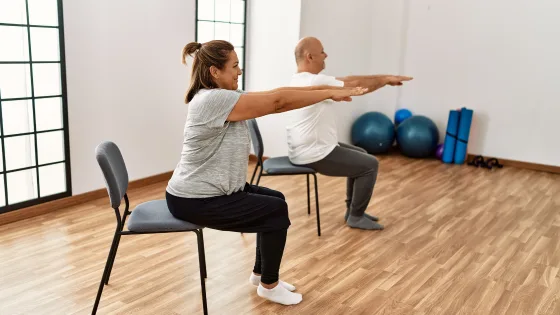
- The Setup: Sit near the front edge of a sturdy dining chair with your feet flat on the floor, hip-width apart. Cross your arms over your chest (or reach them straight out in front for balance).
- The Motion: Lean forward slightly at the hips, press firmly through your heels, and stand up completely to an upright position. Pause briefly, then slowly lower yourself back down into the chair with control—avoiding ploppping down.
- Micro-Dose Goal: Perform controlled repetitions continuously for 30–60 seconds.
2. Standing Calf Raises
Calf raises strengthen the lower legs and ankles, which are essential for ankle stability, push-off power while walking, and preventing backward falls.
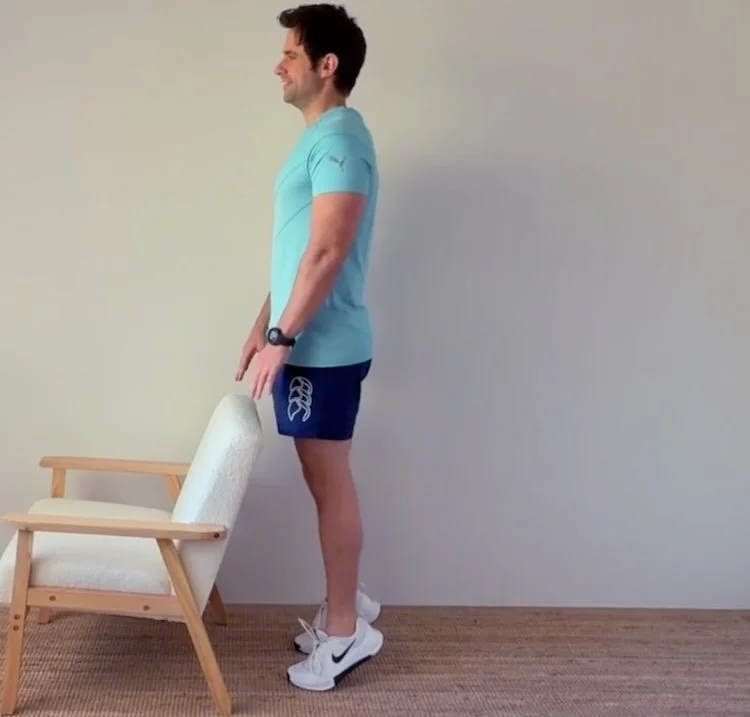
- The Setup: Stand tall behind a kitchen counter, sturdy chair, or wall, placing your fingertips lightly on the surface for balance support.
- The Motion: Slowly rise up onto the balls of both feet, lifting your heels as high as comfortably possible. Hold the top position for a one-second pause, then lower your heels back down smoothly to the floor.
- Micro-Dose Goal: Perform controlled lifts for a 30–60 second interval, focusing on full extension at the top.
3. Seated Knee Extensions
This exercise isolates the quadriceps muscles surrounding the knee joint, improving knee stability and making leg lifting during walking smoother.
- The Setup: Sit upright in a supportive chair with your back straight and feet flat on the floor.
- The Motion: Keeping your thigh on the chair cushion, extend one leg out in front of you until it is straight and parallel to the floor. Squeeze your thigh muscle briefly at the top, then slowly lower the foot back to the starting position. Alternate legs with each repetition or complete a set on one side before switching.
- Micro-Dose Goal: Continue alternating smoothly for a 30–60 second effort.
Takeaway
So, as it turns out, trading our slippers for a microscopic dose of daily movement might just be the ticket to keeping us spry. Who knew that protecting your independence could take less time than brewing a decent cup of coffee? Now, if you’ll excuse us, we have a grueling four-minute regimen to schedule right between our favorite morning television programs.
Source: