On the surface, both the Power Plate and the semi-spherical exercise balls (like the BOSU ball) challenge your body for better balance and stability. However, they achieve this in fundamentally different ways, leading to distinct training effects.
Think of it as two different types of challenge: Instability vs. Reflexive Contraction.
Power Plate: The “Reflexive Contraction” Tool
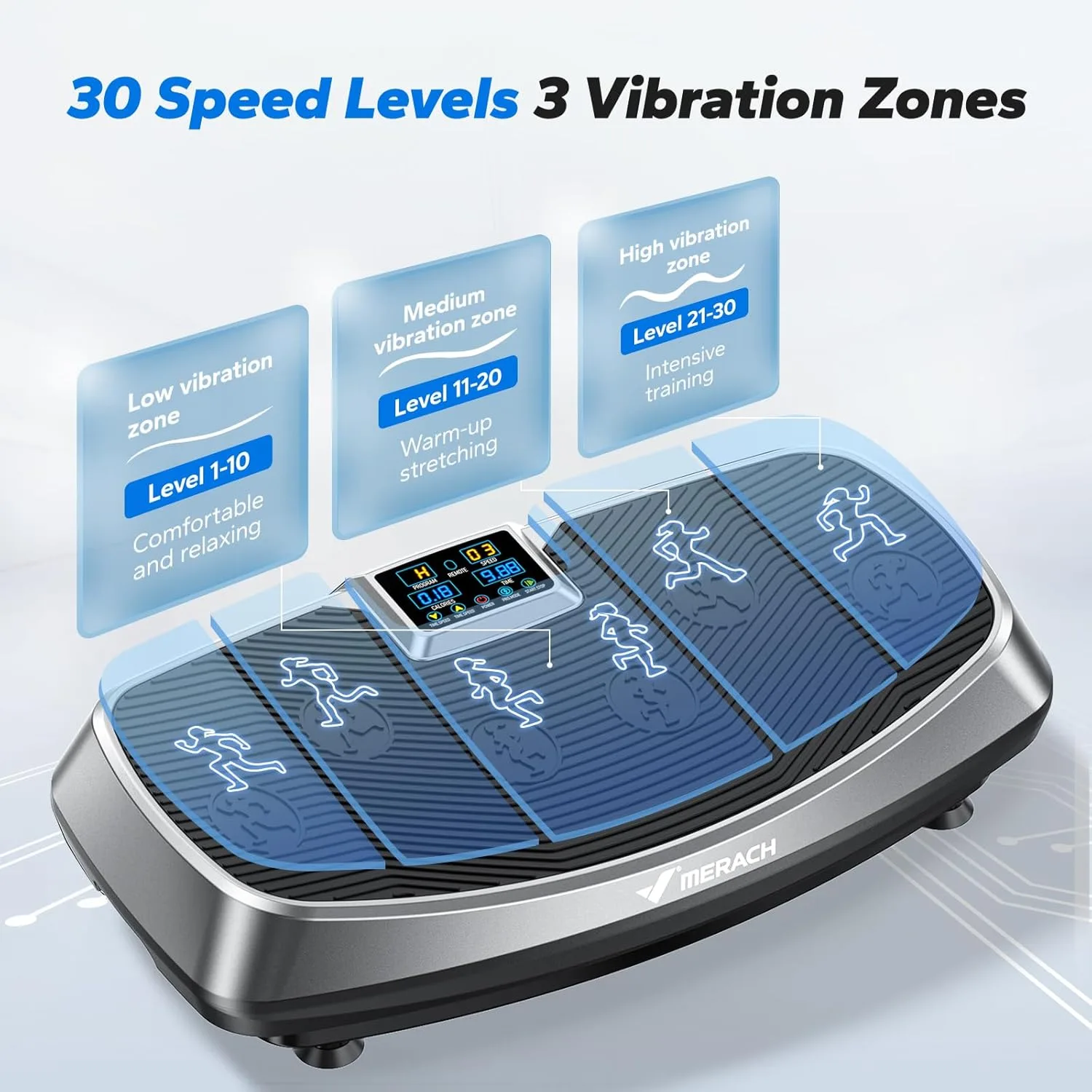
The Power Plate is a machine that uses Whole-Body Vibration (WBV). It’s a piece of powered, high-tech equipment.
| Feature | Description | Primary Mechanism |
| Type of Challenge | Vibration/Frequency | The plate moves very rapidly (30-50 times per second), creating a highly repetitive, mechanical stimulus. |
| Muscle Action | Involuntary Reflex | The rapid vibrations cause the muscles to contract involuntarily via the Tonic Vibration Reflex. Your body isn’t fighting to balance against a wobble; it’s fighting a rapid, consistent stimulus. |
| Focus | Muscle Power, Bone Density, Circulation | The high-frequency mechanical load is the specific stimulus studied to help with bone health and increase muscle activation for strength gains (recruiting up to 95% of muscle fibers). |
| Joint Load | Generally Low-Impact | It allows you to get a highly intense muscle workout (as if lifting heavy) without the heavy joint impact or external load, which is excellent for older adults. |
| Movement | Precise | Power Plate uses a patented Tri-Planar vibration (up/down, side-to-side, front/back simultaneously), delivering a highly controlled and consistent stimulus across the plate. |
BOSU Ball: The “Instability” Tool
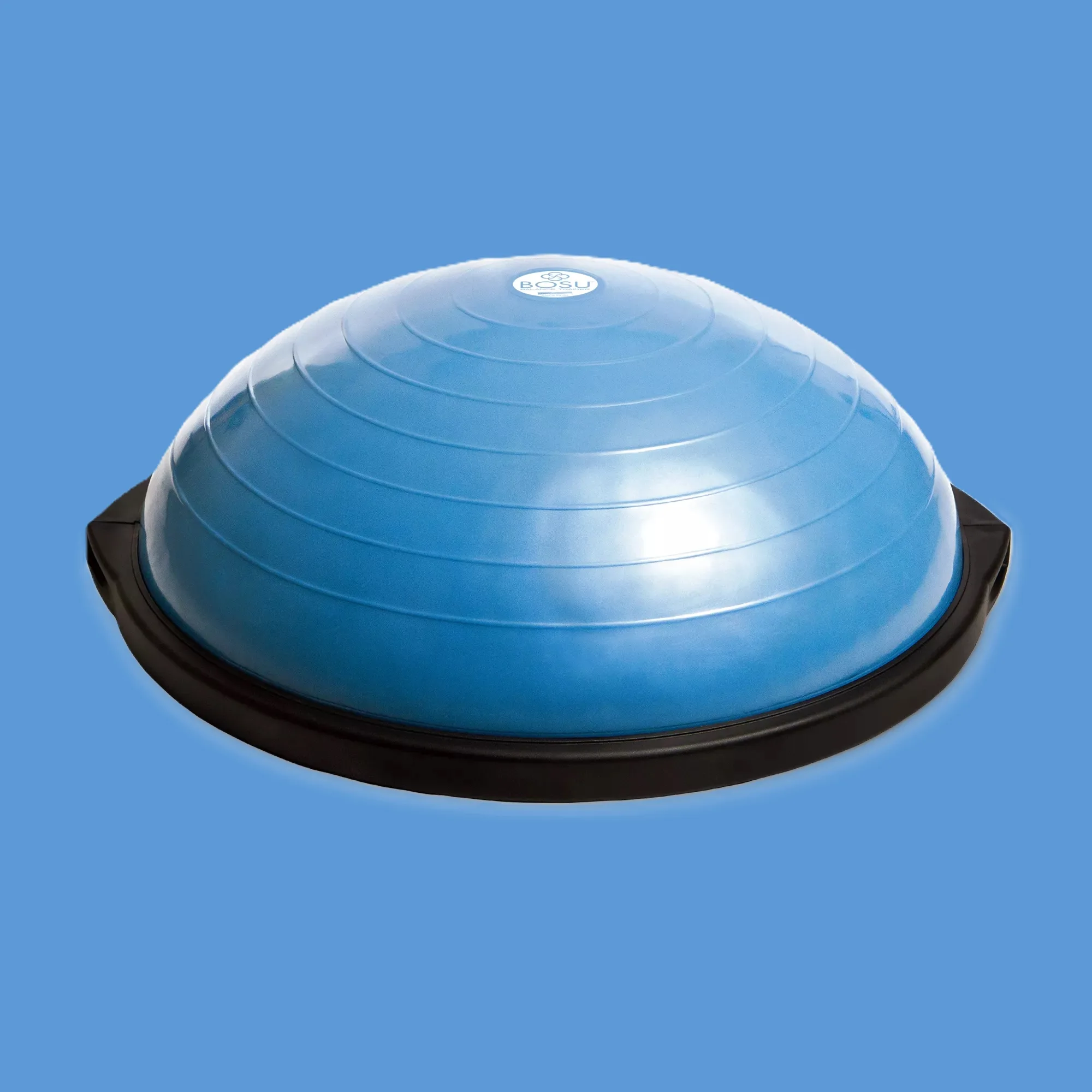
The semi-spherical ball is an inflatable dome with a flat base (often called a BOSU ball). It is a passive, low-tech tool.
| Feature | Description | Primary Mechanism |
| Type of Challenge | Instability/Wobble | The dome creates a soft, constantly shifting, unstable surface when you stand on it. |
| Muscle Action | Voluntary Stabilization | Your body’s core and stabilizing muscles (especially in the ankles, knees, and hips) must consciously and subconsciously fire to keep you from falling over. |
| Focus | Balance, Proprioception (Body Awareness), Core Stability | It excels at training the small stabilizing muscles and improving your sense of where your body is in space (proprioception), which is fantastic for fall prevention. |
| Joint Load | Joint-Friendly | It’s a low-impact way to train, as the soft dome cushions movement. However, the intensity of strength work is often lower because balance becomes the limiting factor. |
| Movement | Gross Movement | The movement is entirely dependent on your balance and the movement of the air/rubber dome. |
🔑 The Main Difference
The biggest difference is the source of the stimulus and the muscle response:
-
Power Plate: Uses mechanical vibration (an external force) that triggers an involuntary muscle reflex to contract rapidly. This mechanical loading is what is specifically studied for increasing bone density and muscle mass efficiently.
-
BOSU Ball: Uses a wobbling surface (an instability) that requires voluntary and involuntary corrections from your stabilizing muscles to maintain balance.
Takeaway
Honestly, prior to writing this article, we were convinced the BOSU Ball had the upper hand. But while both are excellent tools for improving stability, we determined the Power Plate provides a unique, quantifiable load on the muscles and bones that an unstable surface alone, i.e. BOSU Ball, cannot replicate. Therefore, the Power Plate gets our Thumbs Up pick!👍