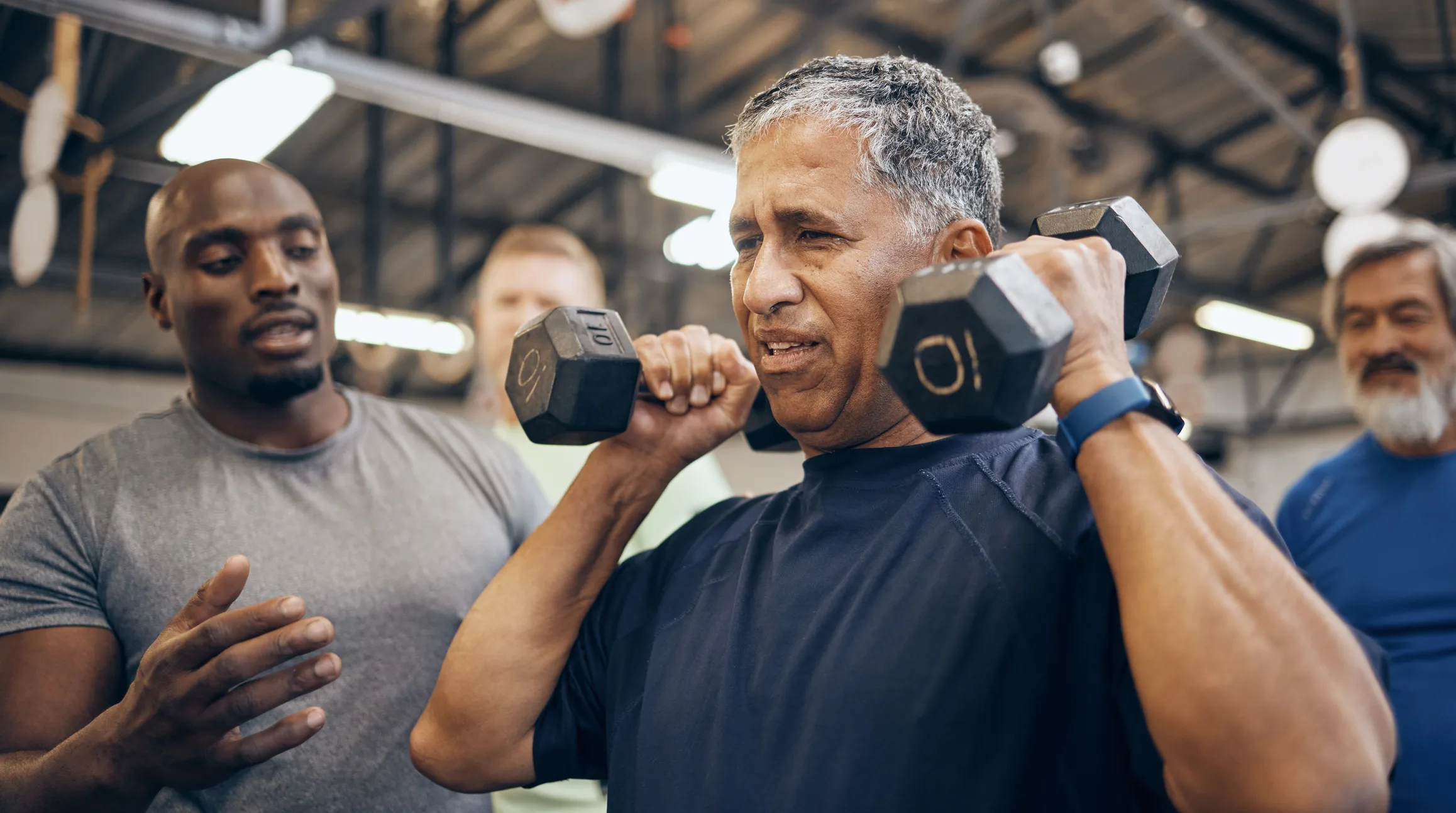
Our balance, strength, flexibility, endurance and cardiorespiratory fitness diminish as we age – but the rate of decline can be slowed as long as we are made aware that we are falling behind early enough. In his book Eat Your Age (Feel Younger, Be Happier, Live Longer), Dr. Ian K. Smith describes 4 test that can be used to determine where you stand physically.
Sit-and-reach test
This test is an indirect measure of hamstring, hip and lower-back flexibility. As we get older, our soft tissues become less elastic, contributing to a loss of flexibility. This test requires a yardstick and someone to help the measurement.
- Find an open space on the floor and place a yardstick down. Hold it in place with a piece of tape at the 15 in mark.
- Sit on the ground with your legs extended and open into a V-shape, with the yardstick between your legs. Place the soles of your feet so that they’re level with the 15 in mark on the yardstick.
- Clasp your hands together in front of you, one on top of the other, then have someone hold your knees down so your legs stay flat on the ground while you slowly reach forward as far as you can.
- Hold it for at least one second and record the distance that you reach.
- Repeat twice more, recording each distance. Choose your best distance.
WHAT IS A GOOD RESULT?
25 years: Woman, 21.5in; man, 19.5in.
35 years: Woman, 20.5in; man, 18.5in.
45 years: Woman, 20in; man, 17.5in.
55 years: Woman, 19in; man, 16.5in.
65 years: Woman, 17.5in; man 15.5in.
3-minute step test
Cardiovascular fitness is your body’s ability to use oxygen to produce energy while you’re engaging in physical activity. This test assesses your fitness level based on how quickly your heart rate recovers after strenuous exercise.
- Use a 12 in step (e.g. a staircase, or step stool) and complete 24 steps per minute for three minutes. Step up on the platform with one foot. Bring the second foot up on the platform. Lower the first foot to the ground, then the second foot. When both feet are back on the ground, that is considered one complete step.
- Within five seconds of completion, measure your heart rate (recovery pulse) for 60 seconds, with your index and middle finger on the inside of your wrist.
- Using the table below, find your age range and recovery pulse, and check how fit you are.

Single-leg balance test
As we get older, our posture and balance change, and often not for the better. Muscles tend to weaken and there are neurological changes that can affect our balance. Stability is key to preventing falls and, in later life, maintaining our independence.
This test is used to assess posture and balance control while standing still.
- Stand upright near a wall or close to a sturdy object that can steady you in the event you lose your balance.
- Place your hands on the sides of your hips and raise one foot off the ground at least 1 ft. Hold your foot in the air as long as you can without taking your hands off your hips and without letting your foot touch the ground. Once either of these happens, the test is over.
- Record your time.
- Repeat, but this time with your eyes closed. Record this time.
- Compare your two times.
WHAT IS A GOOD RESULT?
Ages 18-49: You should aim to balance for about 60 seconds
Ages 50-59: You should aim to balance for about 40 seconds
Ages 60-69: The target is approximately 35 seconds
Ages 70-79: You should strive for 20 seconds
Ages 80 and older: The goal is around 5 seconds
The squat test
This is a good measure of your lower-body strength and muscular endurance. This is not a timed test, rather one that works by doing the exercise until exhaustion and your form breaks down.
- Stand with your feet just a little wider than your shoulders and your toes pointing just slightly outward at an angle.
- Keep your head facing forward in a neutral position aligned with your back. Keep your back straight.
- As you lower your body into the squat position, bend your knees and keep lowering until your knees are at a 90-degree bend and your thighs are parallel to the ground (like sitting in a chair).
-
- As you lower your body, lift and extend your hands out and forward until they are parallel to the ground.
- Throughout, keep your back straight, shoulders back, chest forward, arms extended and feet planted on the ground.
- When your thighs are parallel to the ground, return to the standing position by pushing with your feet, legs and hips and thrusting upward.
- Continue to do the squats until your mechanics break down and you’re unable to do two consecutive squats with proper form. Record that number and compare it with the data in the table below.