Remember when you were a teenager and thought dousing yourself in a whole bottle of cologne or perfume was the secret to attracting a partner? We all have those stories. Well, it turns out the secret to attraction might not be in a bottle you buy at a department store, but in the subtle, natural scents our bodies produce. And for the men out there, a new study is decoding the language of those very smells.
Most of us think of smell as something we only notice when it’s particularly bad—a skunk on the road, or maybe a forgotten gym bag. But a groundbreaking study in the journal iScience suggests that our sense of smell, though seemingly dormant, is still a powerful, subconscious force. It’s like a secret language our brains understand without us even knowing it.
The Chemistry of Attraction
Researchers began by collecting scent samples from 21 women across the four phases of their menstrual cycles. They used special silicone pads placed under the armpits (not the most glamorous part of the study, to be sure!). Then, they had 21 men sniff these samples. The results were a nose-full of surprises.
The men rated the scents from the ovulation phase as significantly more pleasant than those from other times of the month. They described them with words you might hear from a professional perfumer or sommelier: citrusy, grassy, and fragrant—and less musty or vinegary. It seems there’s a whole bouquet of a scent coming from a woman during ovulation.
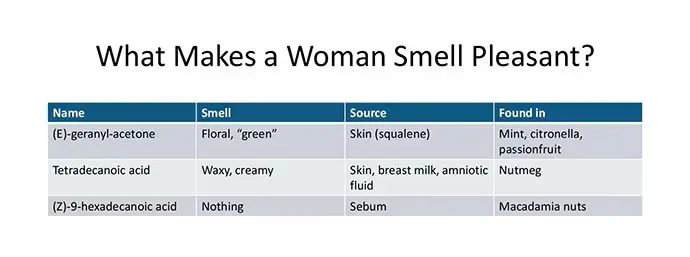
But what exactly are these magical molecules? The scientists put the scent patches under a mass spectrometer and found three key chemicals: (E)-geranyl-acetone, tetradecanoic acid, and (Z)9-hexadecanoic acid.
The first two make a lot of sense. (E)-geranyl-acetone has a green, floral scent, just like the men described. You can find it in things like tomatoes, mint, and citronella. Tetradecanoic acid smells waxy or creamy, and it’s found in breast milk and saliva. It’s a scent that actually makes human babies start to suckle! The third compound, (Z)9-hexadecanoic acid, is a bit of a puzzle because it’s odorless, but it’s a precursor to a compound known for that “old age” smell. Go figure!
A New Kind of Perfume?
With these three chemicals in hand, the researchers created a synthetic “ovulation cocktail.” This is where the study gets really cool. Men were exposed to this lab-made scent without even realizing it. The scent was on the microphone cover of a headset they were wearing while taking surveys.
The result? The men exposed to the synthetic scent reported less hostility, increased “liveliness,” and better concentration. It was like a dose of calm and focus delivered straight to their brains, without them ever consciously smelling a thing.
The study also showed that this scent cocktail could even affect men’s perception of attractiveness. For women who were rated as less attractive overall, the scent actually made them seem more appealing to the men doing the rating. It’s not a magic potion, but it suggests our perceptions are being influenced by cues we’re not even aware of.
Decoding a New Language
So what does this all mean for us? For starters, it’s a fascinating glimpse into the deep, subconscious ways our bodies communicate. It turns out that a “scent of a woman” isn’t just a metaphor—it’s a chemical reality that can influence mood and perception.
As for whether your favorite perfume has these compounds, the answer is probably yes, but good luck finding out which one! The researchers suggest looking for fragrances with notes of citrus, tea, and nutmeg.
This research reminds us that we are all still, in many ways, animals. We respond to an ancient, primal language of scent that we thought we had lost to evolution. While a new cologne probably won’t fix your relationship problems, understanding the subtle power of scent might just unlock a whole new conversation about human connection.
Source: